Quick answer
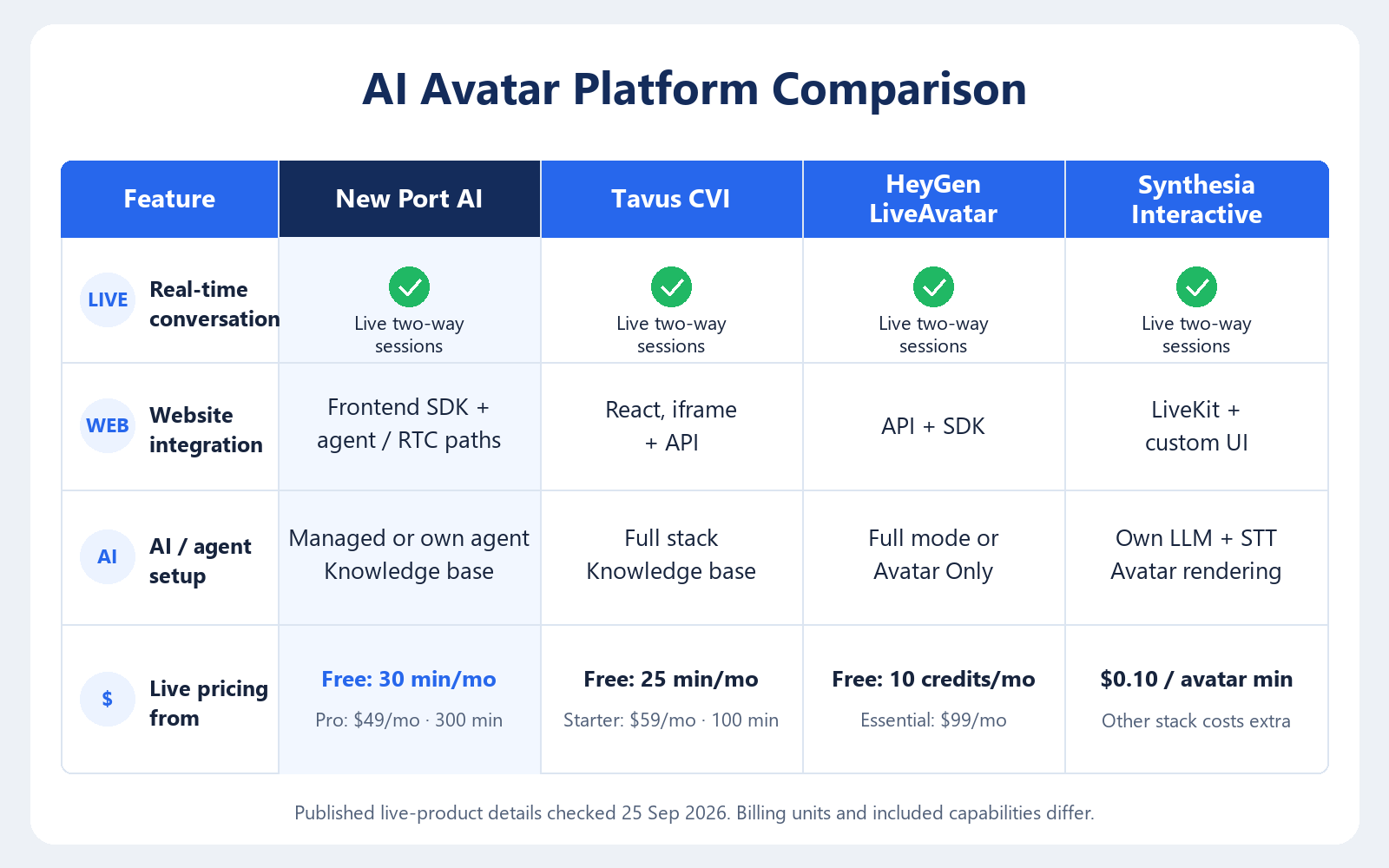
If you need a live avatar on a website, all four products are relevant. New Port AI Live Avatar offers a managed frontend path plus options for teams bringing their own agent or RTC stack. Tavus CVI offers an end-to-end conversation stack that can be embedded in a site or app. HeyGen LiveAvatar offers a managed Full mode or an avatar-only mode for your own AI stack. Synthesia Interactive Avatars fits teams already building around a LiveKit voice agent; it requires a custom UI rather than a no-code embed. These are product-fit summaries based on vendor documentation, not performance rankings.
What counts as a real-time avatar?
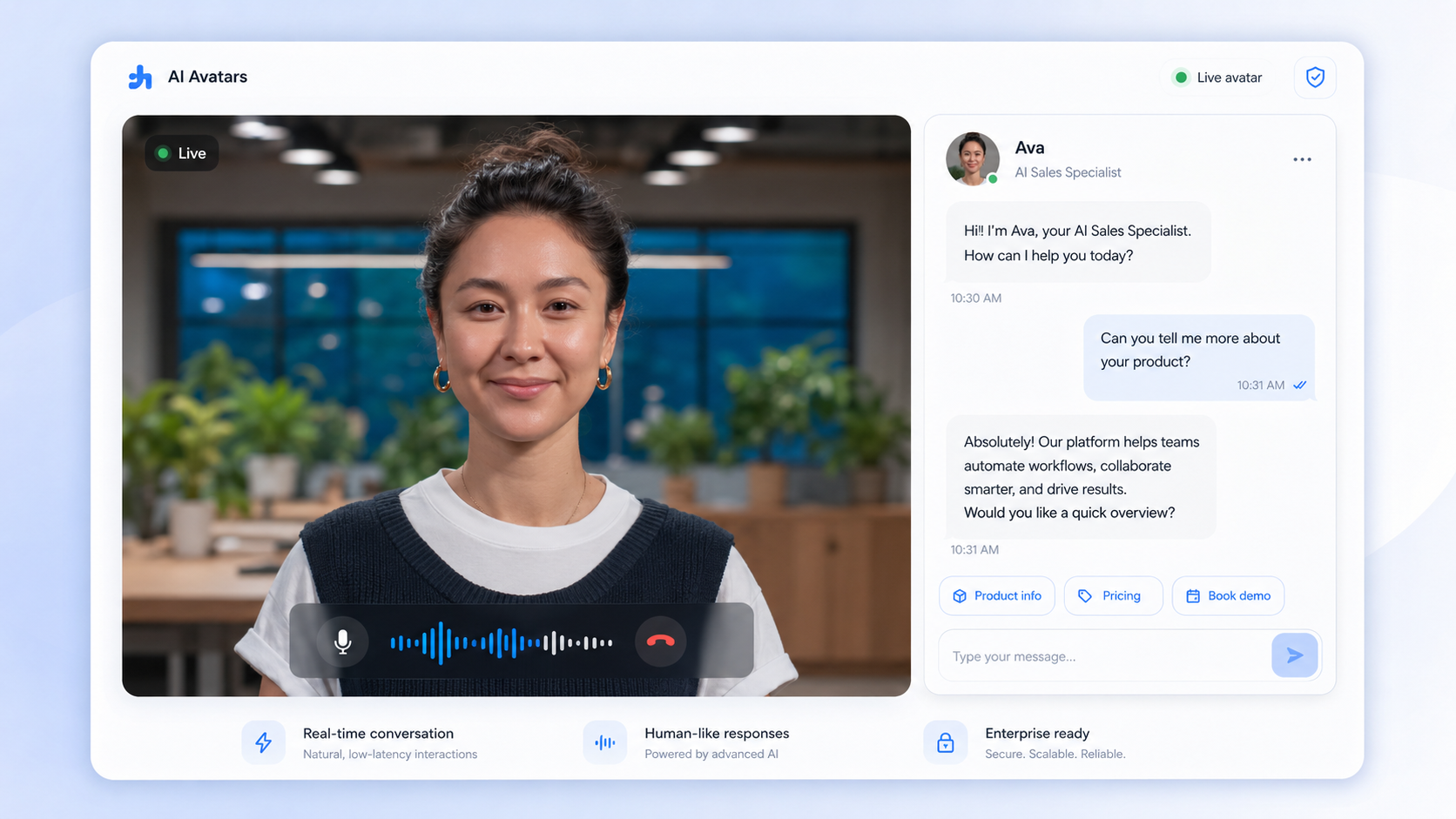
A real-time avatar joins a live session and responds to new input while that session is running. A scripted avatar video is rendered first and played back later. Several vendors sell both, and their video-production subscriptions should not be mistaken for live-session pricing. The comparison below is about live conversational products: New Port AI Live Avatar, Tavus CVI, HeyGen LiveAvatar, and Synthesia Interactive Avatars.
“Real time” also does not mean every provider runs the entire conversation for you. Some supply speech recognition, the language model, and voice generation; others render an avatar driven by an agent you operate. Check that division of work before comparing a monthly subscription or a per-minute rate.
Four real-time avatar platforms compared
New Port AI Live Avatar
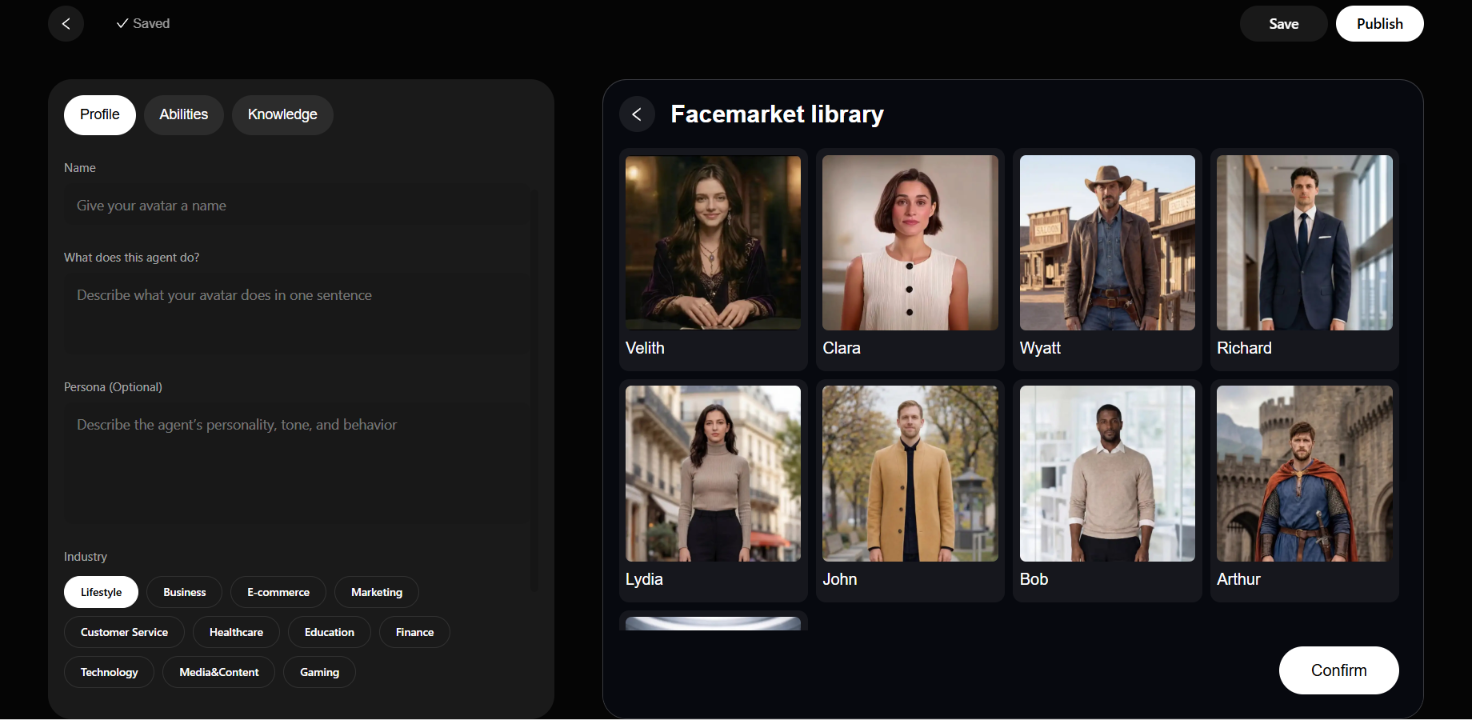
Frontend SDK, WebSocket agent, platform RTC, or your own RTC. Managed conversation and knowledge-base options. Free 30 minutes/month; Professional $49/month with 300 minutes and 4 concurrent sessions. New Port Labs labels the product a limited preview. Integration source · Pricing source.
Tavus CVI
Embeddable real-time conversation via website component, iframe, or API. Tavus documents an end-to-end LLM, voice, and WebRTC stack plus a knowledge base. Basic includes 25 live minutes/month for free; Starter is $59/month with 100 minutes and up to 3 concurrent streams. Starter overage is listed at $0.37/minute. Integration source · Pricing source.

HeyGen LiveAvatar
API and SDK integration. Full mode provides a managed conversational stack; Avatar Only uses your agent and voice stack. Free includes 10 credits/month; Essential is $99/month with 1,100 credits. Full mode uses 2 credits/minute; Avatar Only uses 1. Product source · Pricing source.

Synthesia Interactive Avatars
LiveKit API/plugin with a website UI built by your team. You provide the LiveKit voice agent, LLM, and speech-to-text; Synthesia renders the avatar. Published avatar usage is $0.10/minute; other stack costs may be additional. No no-code embed. Product source · Pricing source.
Where each platform fits
New Port AI Live Avatar
Best fit to evaluate: teams that want a managed start with several paths to a custom agent
New Port Labs describes a frontend SDK path, a WebSocket agent path, a platform RTC path, and a bring-your-own RTC path. The public integration guide explains the distinction: teams can start with New Port managing the voice-to-avatar flow, or connect their own logic and infrastructure. The product page also describes knowledge-base integration.
The public price page lists a free 30-minute monthly allocation, a $49 Professional plan with 300 included minutes, and a $259 Premium plan with 2,000 included minutes. It also labels New Port Labs a limited preview. Ask which features and plans are available to your account before planning a production rollout. This article does not repeat latency figures because New Port’s public pages currently use different latency descriptions without a shared measurement definition.
Tavus CVI
Best fit to evaluate: teams that want an embeddable, end-to-end conversational video stack
Tavus describes CVI as a real-time conversation product that can be embedded through a React component, iframe, or API. Its published stack includes the LLM, speech generation, WebRTC delivery, and a knowledge-base option. The Basic developer plan includes 25 live conversation minutes per month. Starter is $59/month with 100 included minutes and up to 3 concurrent streams; the pricing page lists $0.37/minute for Starter overage and a 30-second minimum per conversation. Check the fit of its UI and agent controls in a live pilot rather than treating published feature claims as test results.
HeyGen LiveAvatar
Best fit to evaluate: teams choosing between a managed voice stack and their own agent
HeyGen’s LiveAvatar is a real-time product. Its Full mode includes the conversational stack; Avatar Only / Lite mode accepts a team’s own agent, speech, and voice components. It offers API and SDK integration for websites and applications. It is incorrect to describe HeyGen as unable to hold a live conversation simply because HeyGen also sells scripted-video products.
Use LiveAvatar pricing for a live-session comparison. HeyGen’s current product page lists Free, Essential at $99/month, Business at $475/month, and custom Enterprise terms. It lists 1,100 credits in Essential. Its documentation explains that Full mode uses two credits per minute and Avatar Only uses one. The available minutes therefore depend on mode, and the standard HeyGen video-creation plan is a different purchase.
Synthesia Interactive Avatars
Best fit to evaluate: teams already building a LiveKit voice-agent application
Synthesia now documents Interactive Avatars for live conversations. In its published architecture, your team runs the LiveKit voice agent and supplies the LLM and speech-to-text; Synthesia renders the live avatar, with an optional built-in text-to-speech path. A website UI must be built by the integrator. The documented avatar charge is $0.10 per minute, while the rest of the conversation stack may be billed separately. Synthesia says stock avatars are not supported for this API, so do not use its scripted-video avatar-library size as a live-session selection criterion.
How to choose for a website deployment
I want a managed starting point and room to customize later
Evaluate New Port AI’s frontend SDK and custom-agent paths alongside HeyGen LiveAvatar’s Full and Avatar Only modes. Ask for a live demo using your own content and expected session length.
I want an embeddable, end-to-end conversation stack
Evaluate Tavus CVI’s website component or iframe alongside New Port AI’s managed frontend SDK. Check the published session limits, minute allowances, and concurrency against expected traffic.
My team already operates a LiveKit voice agent
Evaluate Synthesia’s Interactive Avatar plugin alongside New Port AI’s bring-your-own RTC path and HeyGen’s Avatar Only mode. Compare the work required to connect your existing stack.
My avatar must answer from company documents
Test the actual retrieval flow. New Port AI and Tavus document knowledge-base options; Synthesia supports a bring-your-own retrieval flow; HeyGen’s integration mode determines which conversational components you manage. Ask each vendor to demonstrate answers from your material.
For any short list, run the same sample conversation on the same device and network. Record answer accuracy, interruption handling, first response time, session stability, accessibility, and total cost at your expected traffic. We have not run that test for this article.
Frequently asked questions
Which price should I compare for a live avatar?
Compare each vendor’s live-session product, not a video-export subscription. Include the plan or per-minute rate, included live minutes or credits, session limits, concurrent sessions, commercial license, and the cost of any speech or LLM services you bring yourself. The image and accompanying text above record the public starting points checked for this revision.
Do I need to write code to put an avatar on my site?
It depends on the product and how much control you need. Tavus documents a website component and iframe path. New Port AI documents a frontend SDK with a server-issued session token. HeyGen provides API and SDK integration but says website customization requires development work. Synthesia documents no no-code embed; your team builds the UI around LiveKit.
Is this a hands-on ranking of visual quality or latency?
No. This is a documented-feature and pricing comparison. A measured ranking would require the same test inputs, network conditions, devices, scoring rules, and repeated runs for every provider.
Editorial disclosure: New Port AI publishes this article and offers New Port AI Live Avatar, one of the products compared. This comparison summarizes publicly documented features and prices. We have not conducted a controlled comparison of the four products’ latency, visual quality, or reliability.